Case note · Platform
GEO Studio — measuring what AI says about a brand
A multi-tenant platform for generative-engine optimisation: one central administration console, an isolated workspace per client, ten agent services doing the recurring work, and a publishing pipeline that keeps its own audit trail. Built by us and still running.

Read off the product screens
Not projections — these are counters and configuration values visible inside the running system.
The problem it solves
Being found is no longer the same as being recommended
Measure, produce, publish, re-measure
Every step leaves a record, so a claim about improvement can be traced back to the answers it came from.Rankings stopped being the whole story
People increasingly ask an assistant a question and act on the answer. Whether a business is named, how it is described and whether it is recommended are decided inside generated text nobody controls directly.
You cannot manage what you do not measure
The platform asks a fixed question set across several engines, records the raw answers, and tracks whether the brand appears in them — the same questions each period, so the comparison means something.
Measurement is worthless without production
Knowing you are absent from AI answers does not put you in them. The same platform produces and publishes the content, because the two halves have to close the loop.

What is inside
The central console manages tenants, money, configuration and the agent fleet. Each tenant workspace does the work.
Central administration
Instance management, registration and top-up approval, consumption ledger, AI usage, pricing and global configuration, API management, prompt library and an agent library.
Isolated tenant workspaces
Each client gets its own workspace with its own knowledge base, production counters, publishing accounts and billing state — one client’s work cannot leak into another’s.
Ten agent services
Recurring work is done by agents rather than by hand: title extraction, article writing, image generation, knowledge upkeep, publishing, review and reporting.
GEO audit and reporting
A fixed question set is run across several AI engines on a schedule, the raw answers are archived with hashes, and the report is generated from those records.
Publishing with an audit trail
Extract title, generate article, assign image, queue, publish. A batch that has not finished cannot be run twice, and anything suspected of having published is held for manual check rather than silently retried.
Brand-safety and moderation
Content rules, review queues and a security section with a live counter of blocked probes — the publishing surface is treated as something that will be attacked.
The service model
Six stages, driven from the workspace
Setup (建档)
Company profile, official website, industry and service vocabulary become the reference the rest of the system checks against.
Diagnosis (诊断)
The question set is run across engines and the raw answers are archived, establishing the baseline: present, absent, or described wrongly.
Plan (方案)
Gaps are classified — missing evidence, wrong attribution, or no coverage — and turned into a content plan.
Content (内容)
Titles are extracted, articles generated and illustrated, then queued. Counters on the screen show exactly how much exists at each step.
Publish (发布)
Dispatched across configured platforms, with per-state queues and a manual fallback where a platform requires human confirmation.
Monitor (监测)
The same questions are asked again on the same schedule, so change over time is visible rather than asserted.

Inside the product
Screens from the running system. The interface is Chinese, because the product is built for the Chinese search and assistant ecosystem — we are describing the engineering, not marketing it to a Western audience.
Commercial figures (ledger totals, tenant balances) are redacted in the published images; they are not ours to publish.
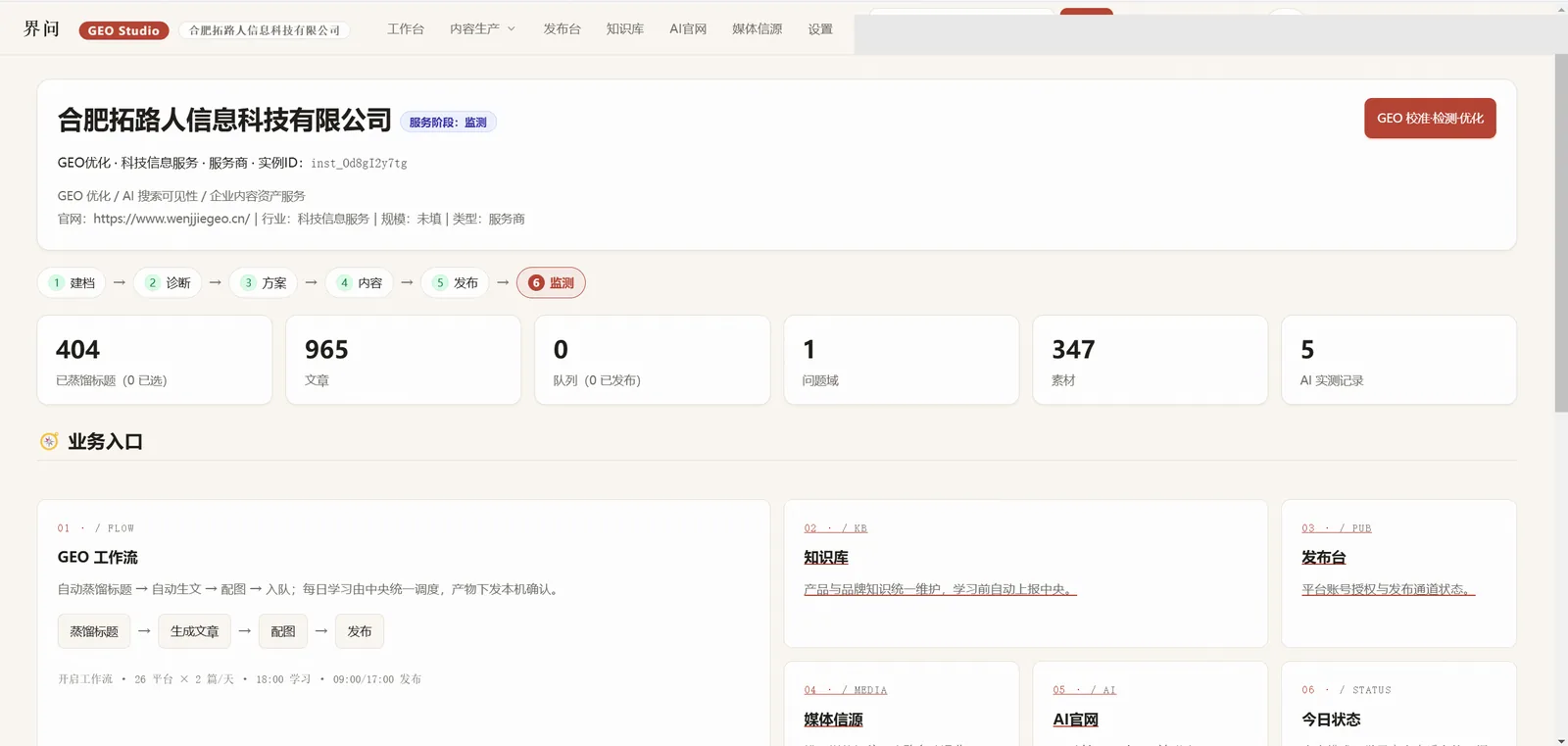
Tenant workspace — service stage, content counters and the six business entry points
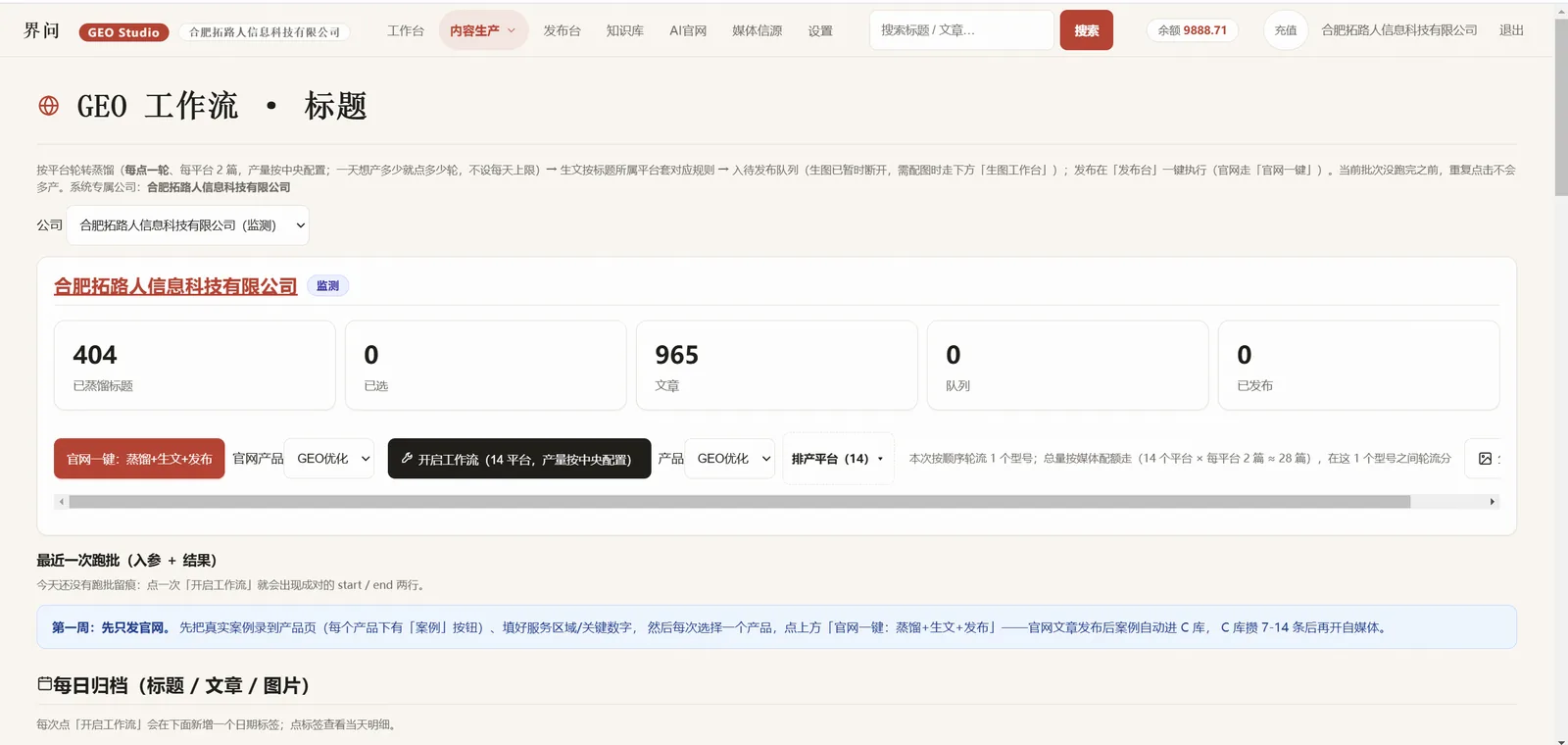
Content production — title extraction, article generation, image assignment and queueing
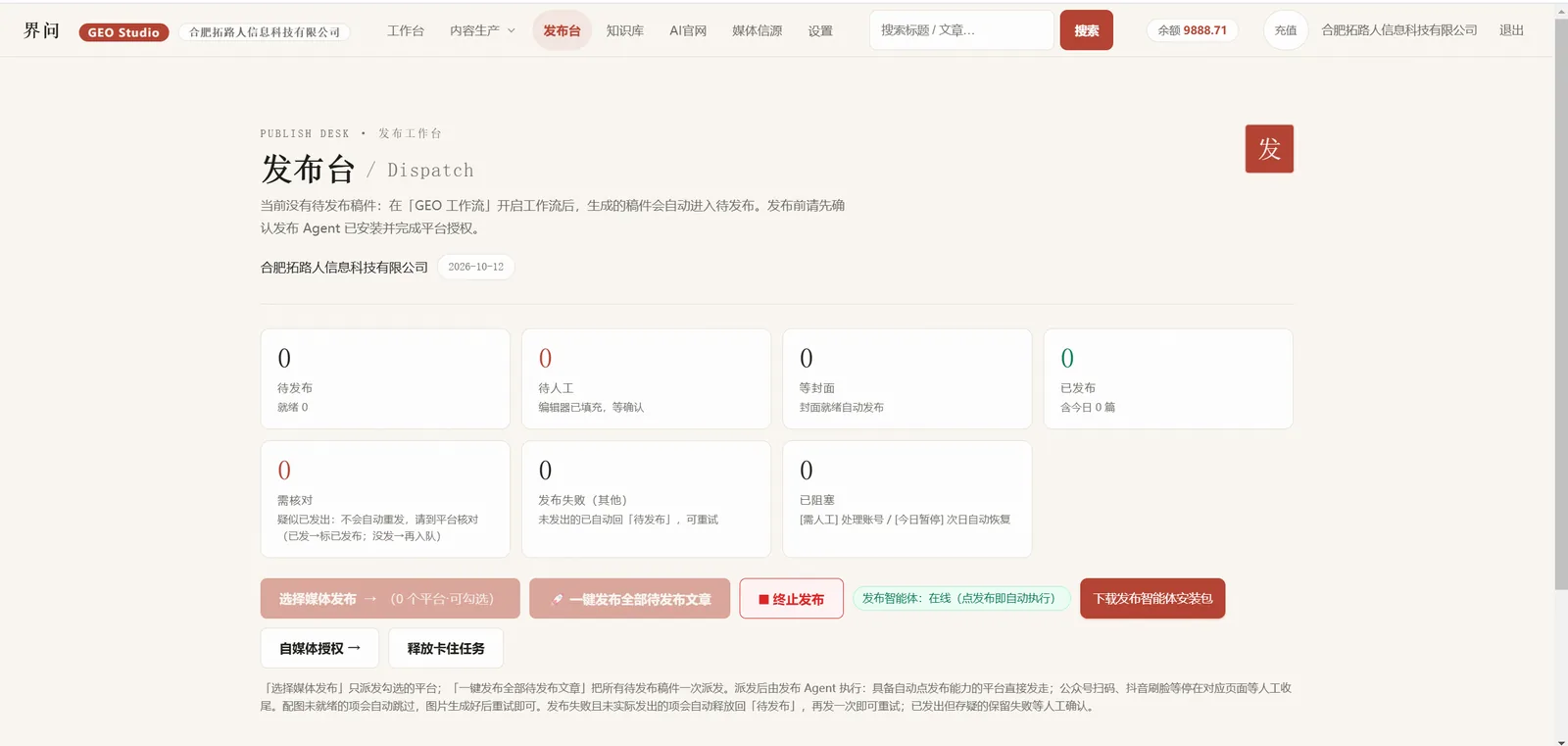
Publishing desk — queue states (ready, manual, awaiting cover, failed, blocked) and dispatch controls

Workspace login — one entry point per tenant
Engineering notes
What was actually hard
A platform, not a script
The interesting parts were the accounting, the separation between tenants, and making every automated action accountable.Making agents idempotent
A publishing batch that has not finished must not run twice, and “did this publish?” has to be answerable. The system holds uncertain cases for manual confirmation instead of retrying and double-posting.
Keeping tenants genuinely separate
One workspace per client, its own knowledge base and credentials. The central console sees counters and billing; it does not reach into a tenant’s content.
Proving a measurement happened
Raw engine answers are archived with hashes, so a report can be re-derived and disputed rather than taken on faith. This is the part clients audit.
Running the AI bill honestly
Every model call is metered per tenant, with usage and cost visible in the console. AI products fail commercially long before they fail technically.

Building something with agents in it?
We can walk through the parts that were hard here — metering, idempotent automation, tenant separation.Bring your own problem and we will tell you which of them you will hit.